
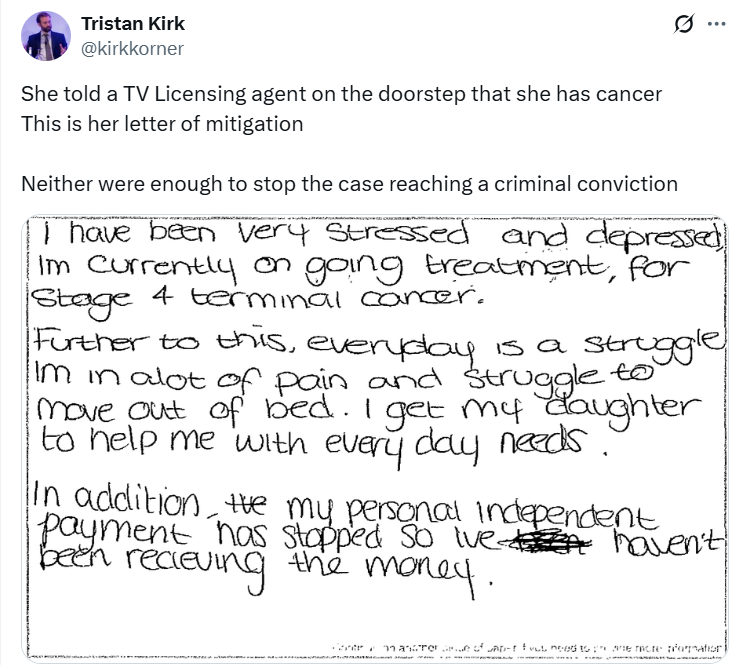
You may have seen Tristan Kirk (court correspondent of the Evening Standard)’s tweets bringing attention to the stories of people who have been convicted under the single justice procedure for crimes like not having up to date road tax or not having a valid TV licence. They lift the lid on the very human cost of an opaque prosecution process. And show that some people who pleaded guilty should either not have been prosecuted or not have pleaded guilty.

SJP cases are heard in a closed court and no-one watches the magistrate as they make their decisions. So Tristan’s approach – asking for the case papers for some SJP cases – is the only way of understanding the circumstances of the people being prosecuted. I thought it might be difficult but possible to get information about particular cases. In the end I had to accept defeat. Tristan and other journalists have access to a weekly list of individual SJP outcomes (the actual sanctions meted out) sent out by the courts service. The first hurdle was to get access to this list. I assumed that as a representative of civil society, I would have equal access to this information. But no – it was only for accredited journalists. Journalism is not my main job, but I do write some comment pieces. So, in the end, to view this list of outcomes of SJP cases, I had to (and did) get journalistic accreditation.
It took tenacity, but at least I had overcome that barrier. Then, when I did get access to the lists, I noticed they were missing some offences which I knew were prosecuted via the SJP. For example, the SJP is used to prosecute parents whose children regularly miss school. I couldn’t see any of these cases, though knew that there are c. 22,000 such prosecutions every year, so the paperwork must be somewhere (a prosecution form is sent to each defendant to be filled in online/in paper). So I contacted courts service (HMCTS) staff who told me that these results were never available on the weekly list sent to journalists because they were entered on a different piece of software. The normal list of SJP outcomes sent to journalists only had cases which had been entered on the Common Platform digital case management system, whereas some cases were only on a different system – Libra.
Courts service staff assured me that SJP Libra results and prosecution forms would be available, but might just need a little more work to find. I was given access to SJP lists for all magistrates’ court cases heard in a few areas and tried to find the results of the SJP cases entered on Libra. It was like looking for a needle in a haystack. I never found the outcome of any Libra SJP case and kept going back to the HMCTS staff, begging them to help me find these Libra cases. They gave me access to yet more court listings, but still no joy. After two months of trawling, none of us seemed to be able to find the outcomes of any of these cases.
This fruitless search made me doubt the many statements made by ministers and in corporate blogs that the SJP is more open than normal court hearings.
In practice, SJP proceedings can be more transparent and accessible than traditional proceedings. Although traditional proceedings are carried out in a public courtroom, very few people attend to observe them. The reality is that magistrates are sitting in a public courtroom, but effectively in private.
In our media protocol, we set out an approach to circulating lists of SJP cases – but we know we have more to do to execute this consistently and are working to make improvements. A reporter can also request both the prosecution statements and the defendant’s representations. Previously they had to attend court in person and write everything down. The public can also ask for the outcome of any case – including SJP.
– Sian Jones, Head of Legal and Professional Services at HMCTS, 2021
This quote doesn’t reflect our experience of open magistrates’ courts hearings. There are often some people in the public gallery – family members of the defendant, or occasionally students or prospective magistrates. We have created a CourtWatch London programme to support members of the public to observe magistrates’ court cases. Magistrates’ courts could be more welcoming to members of the public, but open court hearings are indeed open.
However, it’s practically impossible for a member of the public to find out about SJP cases. Some appear on a list published daily but these are only the Common Platform cases. The thousands of SJP cases which are processed on the Libra system do not appear on any public list. Members of the public can ask for the outcome of any Common Platform individual case (i.e. guilty/not guilty) if they call the phone number given on the page but they can only ask for the outcome of one case in each phone call! Members of the public cannot ask for the papers which reveal details of the SJP case. Whereas in an open court, even when the defendant pleads guilty, observers will hear some context about the offence and the reasons why a sentence might be reduced (mitigation). This information is not accessible to the public for any SJP cases, and not to journalists for the Libra SJP cases.
How can 424,727 criminal cases in one year be hidden from any public or journalistic scrutiny? Well, partly because few journalists are interested in the SJP, and partly because there is no official statement on any website saying that information on these Libra cases is not available to the public and the outcomes not available to journalists. The existence of these Libra SJP cases is literally hidden to all except the prosecutors, the court and the defendants.
Does it matter if thousands of low level cases are hidden from public view? To an extent, no. These are not cases which result in people being imprisoned or even getting a criminal record. They are the lowest level criminal prosecutions. But, they still matter. Many parents are prosecuted via the single justice procedure for the offence of not ensuring their children attend school regularly. This is a strict liability offence which means only certain defences/reasons can be used to justify pleading not guilty. Anecdotal evidence suggests some parents accused of this crime are very vulnerable themselves, and/or have children who face great challenges fitting into school. Without access to court lists or outcomes, there is no way to judge whether these prosecutions are justified and fair. And if they are anything like the cases uncovered by Tristan Kirk, I suspect not.
We have alerted the government and the judiciary to this lacuna in open justice. We’ll update you when these cases are available.
Learn more about the SJP – dive into our new report: Industrial-scale prosecution? Why the single justice procedure needs radical reform or listen to our recent podcast episode: Punished for a mistake? The Single Justice Procedure.